In English
You know how to read kougi, kouku, kouka. Then the four choices come up — 講 航 効 硬 — and you cannot say which one it was. And kouka could be 効果 or 硬貨. You already know there are several kanji read “kou”; what has not stuck is which kanji carries which meaning.
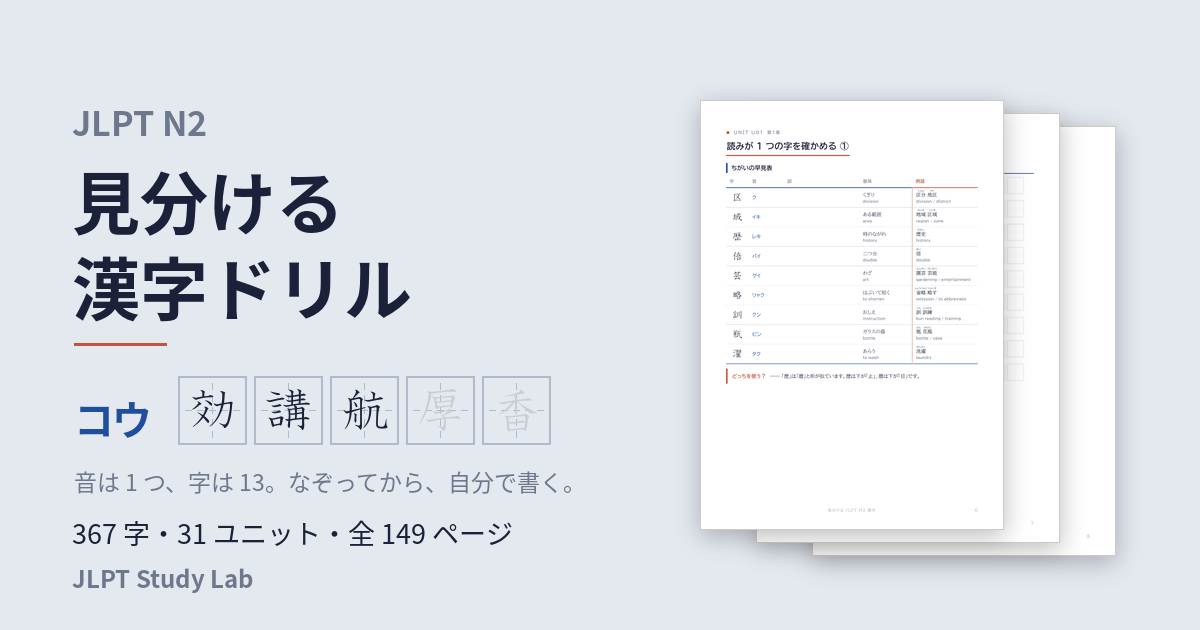
This book puts all 13 kanji read “kou” into a single unit, side by side.
N2 kanji do not trip you up because you have never met them. They trip you up because look-alike readings pile up without ever being separated. That is the one thing this book drills.
How it is arranged
This is not a list of kanji in stroke order or frequency order. Kanji that share a reading sit next to each other, and you tell them apart by meaning and example words.
There are two axes:
- Same sound, different kanji — the kanji read “kou” lined up together
- Same kanji, different readings — the readings one kanji carries, lined up together
A confusable kanji is easier to fix when it is standing next to the kanji you confuse it with. That is exactly the shape the exam presents.
Kanji that merely look alike are not covered. This book is organised by sound.
What you get
| Pages | 149 |
| Kanji | 367 — every N2 kanji, none left out |
| Units | 31, in 6 chapters |
| One unit | 4 pages |
| End of chapter | 6 review drills (10 questions each — 5 reading, 5 writing) |
| End of book | 20-question final test, a list of 17 sets of kanji sharing a kun reading, and an index of all 367 |
| Questions in all | 328 |
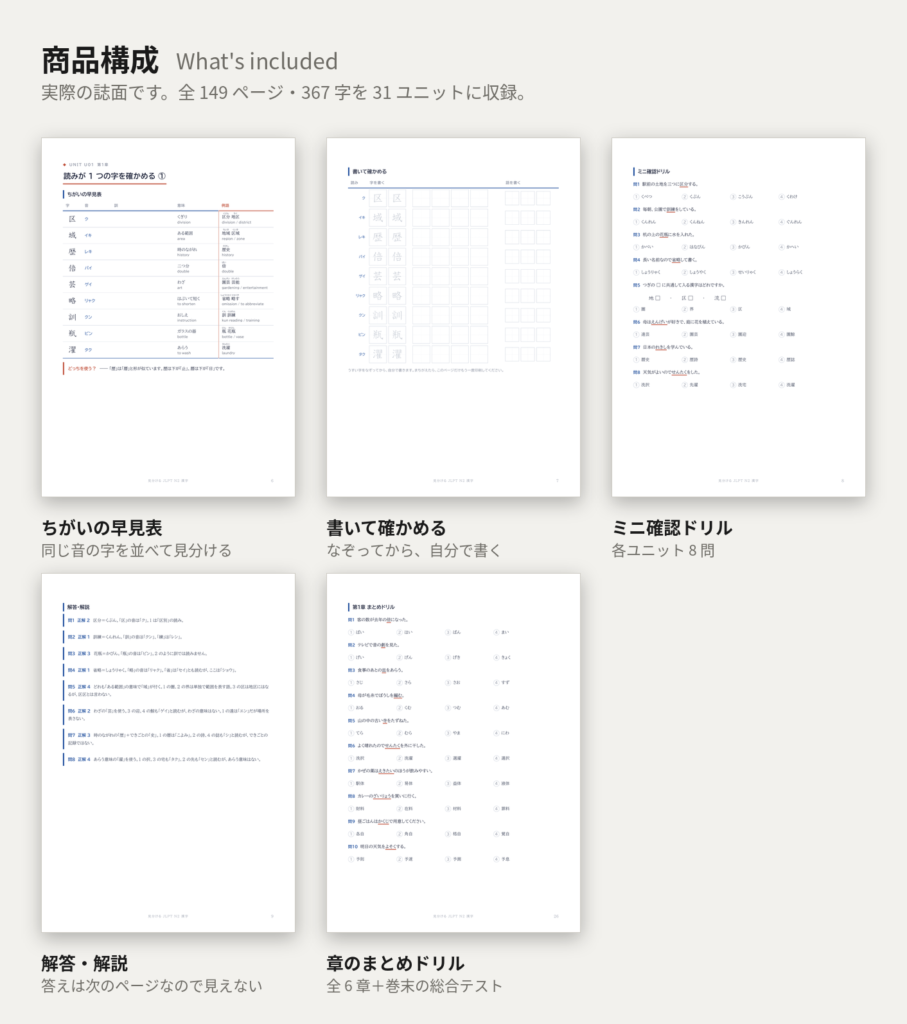
Every unit is 4 pages, and each page has one job.
| Page | What is on it | What you do |
|---|---|---|
| 1 | The difference at a glance | Kanji sharing a sound, side by side — separate them by meaning and example |
| 2 | Write and check | Trace the light characters, then write them yourself |
| 3 | Mini drill, 8 questions | Answer them. The answers are on the next page, out of sight |
| 4 | Answers and notes | Check your work |
The first 4 questions are reading (see the kanji, choose the reading); the last 4 are writing (see the reading, choose the kanji).
- Meanings and example words in the glance table carry English. The questions stay in Japanese,
so you answer them under the same conditions as the exam
- Example words carry furigana
- The characters you trace are set in a textbook typeface — the shape a hand actually writes
- Readings are limited to the jōyō kanji table (Japanese government listing)
Print it again as many times as you need
The writing pages can be printed over and over. This is why the book is sold as a PDF.
A paper book cannot be un-written. Come back to a page a second time and your first attempt is still sitting there — tracing over a visible answer is not practice, and buying a second copy is not realistic. An app leaves nothing behind, but it cannot make you write by hand; dragging a finger across glass is not the same movement as a pencil on paper, and kanji writing lives largely in the hand.
With a PDF you print just the page with the kanji you got wrong.
- Work through every unit once
- Note the kanji you dropped when you check your answers
- Print the page they sit on, and write them again
- As many times as you like, always from blank
Units are cut into 4 pages partly for this. You can aim at exactly the pages you need — the week before the exam, print only the kanji you keep dropping.
How this sits with our first title
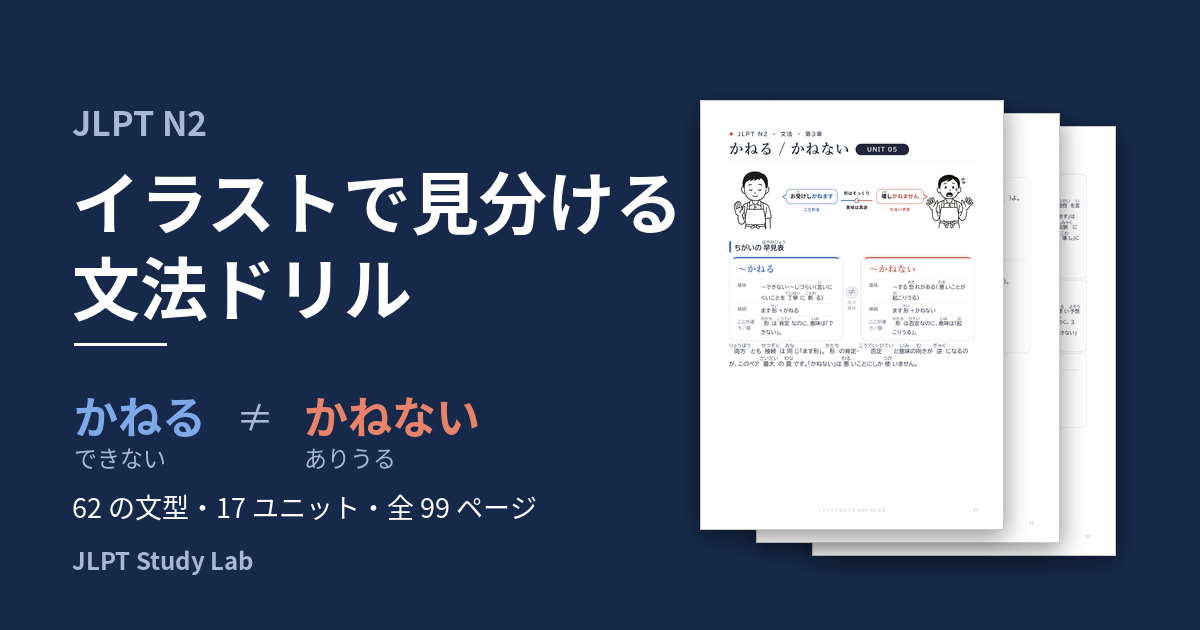
“Illustrated JLPT N2 Grammar — Confusable Sentence Pattern Pairs” is on the same shelf. This is our second title, but it is a different kind of book rather than a sequel.
| First title (N2 grammar) | This book (N2 kanji) | |
|---|---|---|
| What it is | A book you read to understand | A book you print and write in |
| What it covers | Confusable grammar pairs | Kanji that share a sound |
| What you mainly do | Grasp the difference through tables and pictures | Trace, write, answer |
Commercial publishers sell the main book and its workbook as separate products too — Kanji Look and Learn, for instance, is 272 pages, with a 176-page workbook alongside it. The relation here is the same.
Either one stands on its own, and there is no set order. Stuck on grammar, take the first; stuck on kanji, take this one.
Format
A PDF you download. It reaches you the moment you buy it. Print it, or read it on screen.
About the coverage
The range covered here follows the JLPT list published by Tanos.co.uk (CC BY) and is a study guide, not the exam’s syllabus. The Japanese Language Proficiency Test has not published its syllabus since the 2010 revision.
With no published syllabus, no material can promise “learn these and they will appear.” Nor does this one. What this book takes on is getting you to tell apart the 367 kanji widely treated as N2 — by standing each one next to the kanji you confuse it with.
日本語
こんな人のための本です
「こうぎ」「こうくう」「こうか」。読みは分かるのに、選択肢に「講」「航」「効」「硬」が並んだ瞬間、どれだったか決められない。しかも「こうか」は効果と硬貨のどちらもありえます。「コウ」と読む字がいくつもあることは知っているのに、どの字がどの意味だったかが結びついていない。
本書は、この「コウ」と読む字を 13 字まとめて 1 つのユニットに置いています。
N2 の漢字でつまずくのは、字を知らないからではなく、似た読みの字が区別されないまま増えていくからです。この本は、そこだけを練習します。
何がちがうか ―― 音でまとめて、見分ける
この本は、漢字を画数順や出題頻度順に端から並べた一覧ではありません。同じ音の字を隣どうしに置いて、意味と例語で見分けるという並べ方をしています。
軸は 2 つです。
- 同じ音・ちがう字 … 「コウ」と読む字を並べて、意味と例語で見分ける
- 同じ字・ちがう読み … 1 つの字が持つ複数の読みを並べる
まぎらわしい字は、単独で覚えるより、まぎらわしい相手と一緒に置いたほうが見分けやすくなります。試験の選択肢は、まさにその形で出てきます。
なお、形の似ている字の弁別は入れていません。音でまとめた本です。
中身
| ページ数 | 149 ページ |
| 収録漢字 | 367 字(N2 の漢字を全部入れています。絞っていません) |
| ユニット | 31 ユニット/6 章 |
| 1 ユニット | 4 ページ |
| 章末 | まとめドリル 6 本(各 10 問=読み 5・表記 5) |
| 巻末 | 総合テスト 20 問、同じ訓の字 17 組の一覧、音訓さくいん 367 字 |
| 設問の総数 | 328 問 |
1 ユニットは 4 ページ、やることが決まっています
| ページ | 何があるか | 何をするか |
|---|---|---|
| 1 | ちがいの早見表 | 同じ音の字を並べて、意味と例語で見分ける |
| 2 | 書いて確かめる | うすい字をなぞってから、自分で書く |
| 3 | ミニ確認ドリル 8 問 | 解く。答えは次のページなので見えない |
| 4 | 解答・解説 | 答え合わせ |
ミニ確認ドリルは、前半 4 問が読み(漢字を見て読みを選ぶ)、後半 4 問が表記(読みを見て漢字を選ぶ)です。答えは次のページにあるので、解いている間は目に入りません。
作りについて
- 早見表の意味と例語には英語を添えています。ただし設問は日本語のままです。本番と同じ条件で解けるようにしてあります
- 例語にはふりがながついています
- なぞる字は教科書体です。手で書く字の形で刷ってあります。明朝体の飾りは手書きに存在しないので、書き取りに明朝を使うと、ちがう字形を教えることになります
- 読みは常用漢字表(内閣告示)の範囲に限っています
何度でも刷り直せます
書き取りのページは、同じページを何度でも印刷できます。この本を PDF で出している理由が、ここにあります。
紙の本は、一度書き込んだら元に戻りません。2 回目に同じページを練習したいと思っても、そこには前回書いた答えが残っています。答えが見えている状態でなぞるのは、練習になりません。だからといって 2 冊目を買うのは現実的ではありません。
アプリは、書き込みが残らない代わりに、手で書かせることができません。指やペンで画面をなぞる形式はありますが、紙に鉛筆で書く運動とは別のものです。漢字の書き取りは手が覚える部分が大きく、そこを省くと、読めるけれど書けない状態になりがちです。
PDF なら、まちがえた字のページだけをもう一度出して書けます。
- 1 回目は全部のユニットを通して解く
- 答え合わせで落とした字を控えておく
- その字が載っているページだけを、もう一度印刷して書く
- 何度でも、まっさらな状態から書ける
ユニットが 4 ページで区切られているのは、この使い方のためでもあります。必要なページだけを狙って出せます。試験の直前に、落とした字だけを集めて刷り直す、という使い方ができます。
第 1 弾との関係
同じ売り場に「イラストで見分ける JLPT N2 文法 ― まぎらわしい文型ペア ドリル」が並んでいます。本書はその 2 冊目にあたりますが、続編というより、種類のちがう本です。
| 第 1 弾(N2 文法ドリル) | 本書(N2 漢字ドリル) | |
|---|---|---|
| 何の本か | 読んで理解する解説書 | 刷って書く練習帳 |
| 扱うもの | まぎらわしい文型のペア | 同じ音・ちがう字の漢字 |
| 主な作業 | 対比表とイラストで意味のちがいをつかむ | なぞって書く・解く |
市販の教材でも、本体とワークブックは別の商品として売られています(たとえば Kanji Look and Learn は本体 272 ページ、ワークブックが 176 ページで、それぞれ別の本です)。本書と第 1 弾の関係も、これと同じです。
どちらか一方だけを買っても、それぞれ独立して使えます。順番の決まりもありません。文法で迷っているなら第 1 弾、漢字で迷っているなら本書です。
形式
ダウンロードして使う PDF です。買ったその場で受け取れます。印刷しても、画面で読んでも使えます。
収録範囲について
本書の収録範囲は、Tanos.co.uk が公開している JLPT リスト(CC BY)にもとづく学習用の目安です。JLPT の出題範囲そのものではありません。日本語能力試験は 2010 年の改定以降、出題範囲を公開していません。
出題範囲が非公開である以上、どの教材も「これを覚えれば出る」とは言えません。本書も同じです。この本が引き受けているのは、N2 の漢字として広く扱われている 367 字を、まぎらわしい相手と並べて見分けられるようにするところまでです。