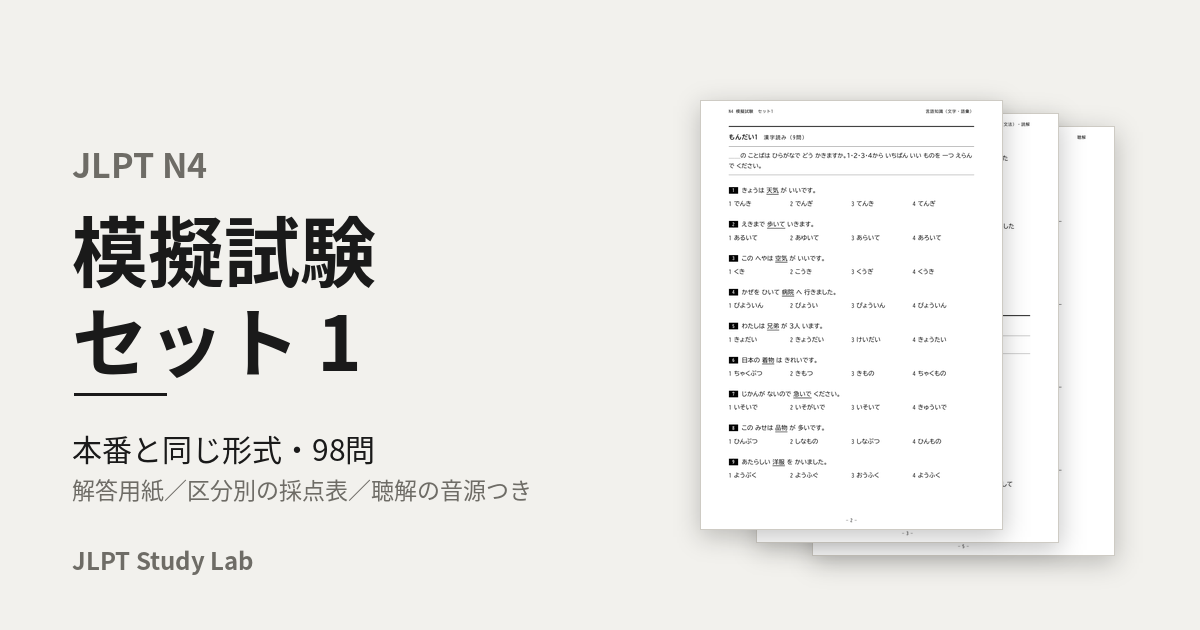
Once you have worked through the N4 grammar and vocabulary, you usually reach the same place: you know the material, but you have never sat the actual test format. Word lists and drills are easy to find. A paper you can sit straight through ― 98 questions, timed ― is not.
So we made one. Print it, put a clock on the desk, and sit it.
What’s inside
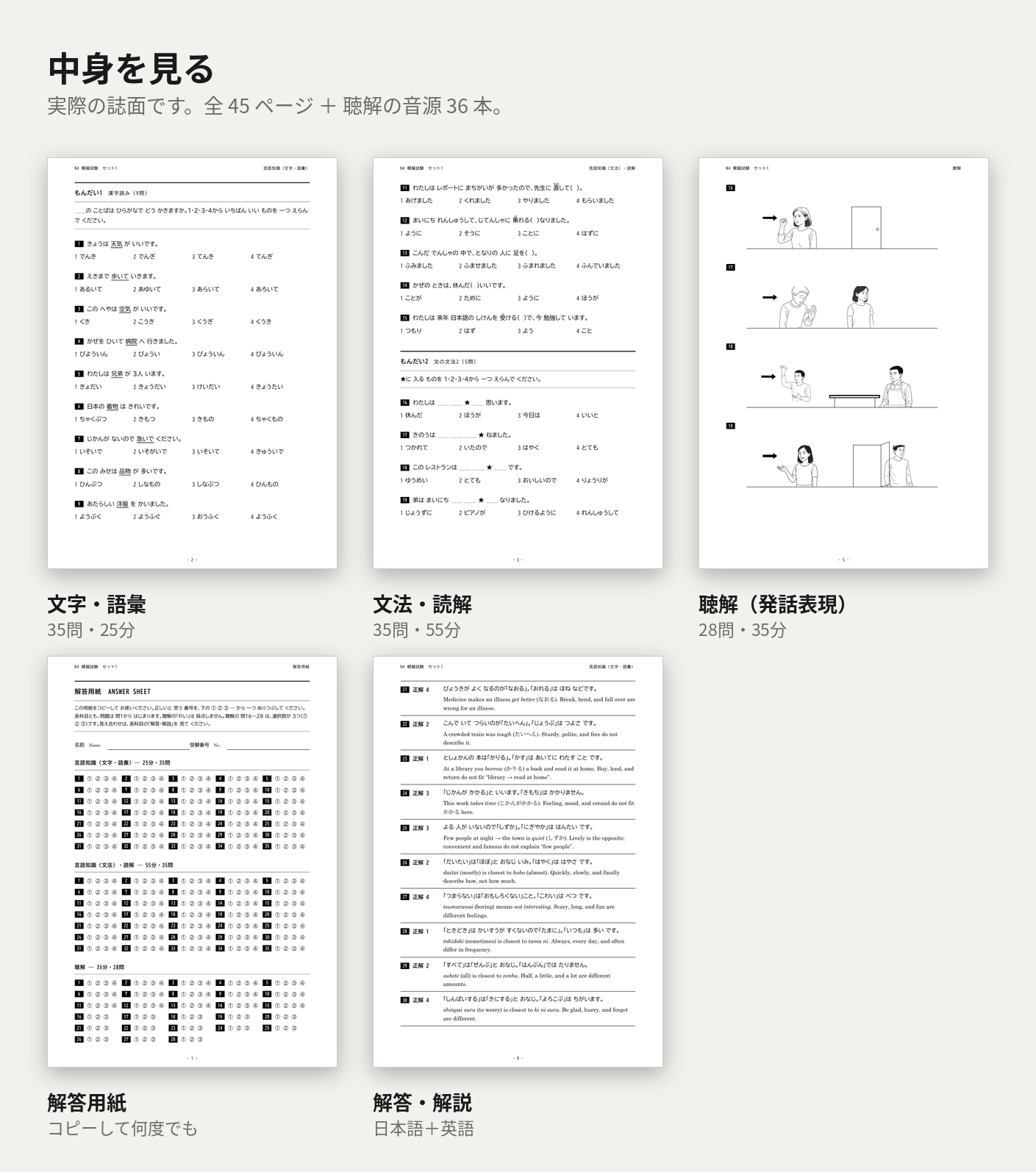
45 pages plus 36 audio files for the listening section.
| Language Knowledge (Vocabulary) | 25 min, 35 questions |
| Language Knowledge (Grammar) / Reading | 55 min, 35 questions |
| Listening | 35 min, 28 questions |
| Answer sheet | Mark-sheet format. Photocopy it and sit the paper again |
| Score sheet | By section, the same two-part pass rule as the real exam |
| Answers and explanations | All 98 questions, in Japanese and English |
The number of parts, the number of questions and the time limits follow the current N4 (the N4 time limits changed in December 2020; these are the current ones).
Three things we were careful about
1. Scoring is done by section
A single total does not tell you whether you would pass. The N4 has a minimum score for Language Knowledge / Reading and a separate minimum for Listening. Miss either one and you fail, whatever your total.
The score sheet keeps that two-part rule, so the most common way to fail ― a total that clears the bar while Listening alone falls short ― shows up immediately.
The conversion from raw marks to scaled section scores is not published by the organisers. The figures on our score sheet are an estimate. Use it to find your weak section, not as a verdict on whether you would pass.
2. Real audio for the listening section (36 files)
Listening practice needs sound. You get 4 files covering whole parts, 28 single-question files, and 4 example files.
Use the whole-part files when you sit the paper, and the single-question files when you go back over your mistakes. The pauses for writing your answer are baked into the audio, so play it through without stopping. If you pause it, you lose the sense of the real timing.
Part 3 (utterance expressions) has illustrations printed on the page, exactly as in the real exam ― that part cannot be answered from audio alone.
3. Explanations say why the other three are wrong
Explaining only the correct answer means you make the same mistake next time. Every question also explains why the three you did not choose do not work here. Japanese comes first, English second, so you can check the English if the Japanese explanation is hard.
How to use it
- Sit it straight through, timing each section. Do not look at the answers part-way
- Write on the answer sheet, not in the booklet, so you can sit it a second time
- Score it by section, not as a total
- Go back only to the questions you got wrong, using the single-question audio and the explanations
No past exam questions
Every question is newly written. We matched the format and the difficulty of the real exam and nothing else. No past exam material is reproduced.
The vocabulary, kanji and grammar lists come from JLPT Resources by Tanos.co.uk, used under Creative Commons Attribution (CC BY), and every question is written within that range. The questions, choices, explanations and audio are all newly produced by AOGUMI LLC.
Note that the JLPT has not published an official scope since the 2010 revision. The lists above are not official ― we use them as a constraint on ourselves when writing.
What’s next
Further sets are being made in the same format. Start with this one, under the clock. You will find out whether your problem is running out of time or losing the Listening section ― and once you know where you actually fall down, the rest of your study gets much faster.